

Messages from Keidanren Executives and Contributed articles to Keidanren Journals February, 2026 Businesses and Biodiversity: New opportunities with Other Effective Area-Based Conservation Measures (OECMs)

The loss of biodiversity is accelerating globally, and there is growing recognition that both halting and reversing this loss requires action from all of society, in addition to governments, civil society organisations, Indigenous peoples, local communities and the private sector.
The Kunming-Montreal Global Biodiversity Framework (GBF), adopted in 2022 at the 15th Conference of the Parties (COP15) to the Convention on Biological Diversity (CBD), is a framework for all actors, a global plan for the whole of government and the whole of society. While Target 15 of the GBF specifically calls on businesses to assess, disclose and reduce biodiversity-related risks and negative impacts, another target is attracting significant attention for its potential to create new opportunities for non-state actors, especially businesses, to contribute directly to biodiversity conservation.
This is Target 3, which calls for the effective conservation and management of at least 30% of terrestrial and inland waters, and of coastal and marine areas, by 2030. This target, widely known as "30x30", is critical to the GBF's overall objective to halt and reverse biodiversity loss by 2030 and has gained a lot of interest within and beyond the existing conservation community.
One of the pathways for achieving this target is through OECMs, which is the topic of this article. Within the 30x30 context, OECMs refer to sites (delimited areas) that deliver the long-term conservation of biodiversity.
A key characteristic of OECMs is that they support effective in situ conservation of biodiversity outside designated protected areas and have governance systems led by diverse actors that can include the private sector, Indigenous peoples and local communities, as well as government agencies.
In essence, while protected areas are defined by their management objectives, OECMs are distinguished by the biodiversity conservation outcomes they deliver.
OECMs is not a new concept; they were first referenced at the time of the Aichi Targets agreed at CBD COP10 in 2010. However, their definition was only agreed within the Convention eight years later, at COP14. Subsequently, when the GBF was adopted in 2022, OECMs gained significant attention as a novel pathway to implement the 30x30 target.
IUCN, invited by the Parties to the CBD to assist them in identifying OECMs and in applying the scientific and technical advice, has issued global guidance and supplementary reports in multiple languages, led by the IUCN World Commission on Protected Areas (IUCN-WCPA). Furthermore, it supports the effective adaptation of OECMs in various countries through learning tools such as videos, webinars, and podcasts.
OECMs have four core criteria agreed under CBD, which the IUCN guidance also follows: Criterion A. Area is not currently recognized as a protected area; Criterion B. Area is governed and managed; Criterion C. Achieves sustained and effective contribution to in situ conservation of biodiversity; and Criterion D. Associated ecosystem functions and services and cultural, spiritual, socio-economic and other locally relevant values.
As previously noted, OECMs are geographically defined areas, other than protected areas, that are governed and managed in ways that deliver positive and sustained long-term outcomes for the in-situ conservation of biodiversity, along with their associated ecosystem functions and services, and—where relevant—cultural, spiritual, socio-economic and other locally important values. Recognising OECMs provides valuable opportunities to highlight and support existing governance systems and management practices that contribute meaningfully to biodiversity conservation. They help strengthen ecological connectivity, enhance ecosystem services, and ensure more effective, representative, and well-integrated conservation networks across landscapes, seascapes and inland waters.
On the other hand, some challenges are already known, including a worldwide gap in knowledge and expertise, the risk that the OECM framework may be misapplied to ecologically degraded areas or in ways that infringe on rights, and the need to enhance and strengthen incentives and benefits for reporting OECMs.
As of November 2025, 6,594 OECMs from 16 countries, including Japan, are reported to the "World Database on OECMs" jointly owned by IUCN and UNEP, managed by UNEP-WCMC. While 16 countries may seem a small number, this reflects the fact that the potential is far from fully realised; indeed, more countries are currently exploring the adoption of OECMs. By the target year of 2030, it is likely that OECMs will be reported from a much greater number of countries.
IUCN recognises Japan as one of the countries that has swiftly advanced its efforts to explore the potential of OECMs in their national context. Japan's OECM framework is particularly intriguing in its collaboration with the non-state sector, particularly businesses. Some of the business sector stakeholders reading this article may already be involved in conservation efforts through the Japanese national OECMs framework. The high level of interest and contribution from businesses to biodiversity conservation through this framework is a particularly encouraging development. Our survival, prosperity and health as humans relies on the health of our planet — investing in conservation means investing in our collective future.
I would like to highlight again that the core of OECMs lies in achieving long-term in situ conservation of biodiversity, which cannot be accomplished overnight. In September 2027, the IUCN World Protected and Conserved Areas Congress, the world's premier global forum for setting the agenda for protected and conserved areas, will be held in Panama. We are looking forward to hearing experiences from Japan on their road to ensuring the long-term and effective in situ conservation of the beautiful nature of Japan.
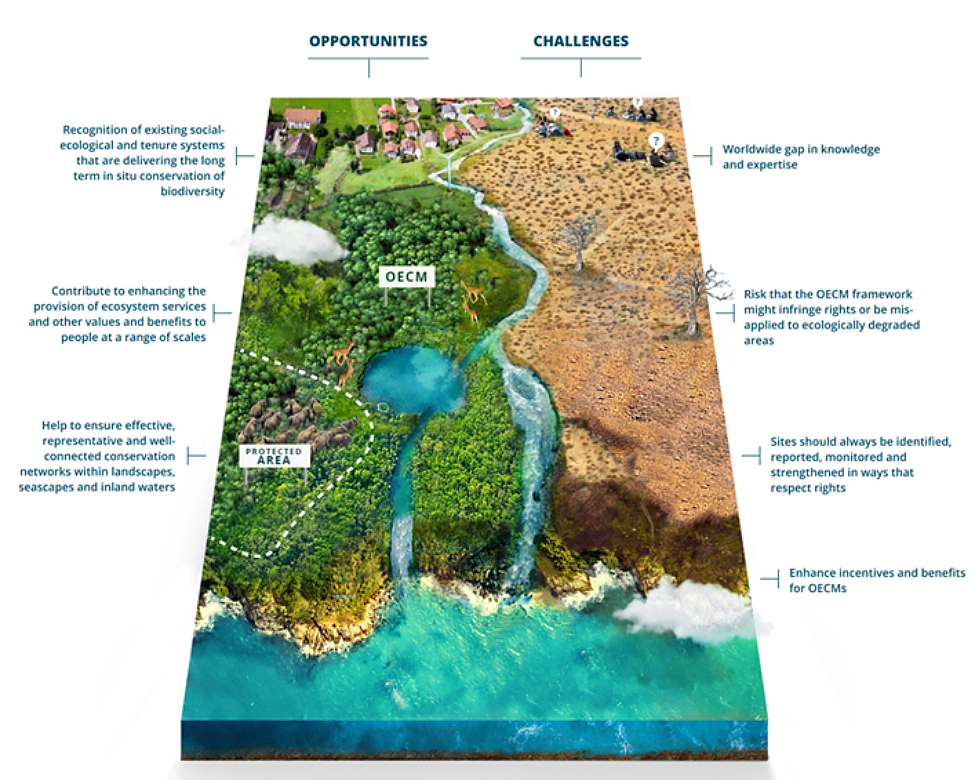
Title: The OECM framework is generating a range of opportunities and challenges
(Source: Jonas, H. D., Wood, P. & Woodley, S., Volume Editors (2024). Guidance on other effective area-based conservation measures (OECMs). IUCN WCPA Good Practice Series, No.36. Gland, Switzerland: IUCN, p. 3 Figure 1., Adapted from WWF. (2022). Backing the Stewards of Nature: Supporting local approaches to global conservation targets through other effective area-based conservation measures. Washington, DC: WWF-US)