

KEIDANREN (Japan Business Federation) is a comprehensive economic organization with a membership comprised of 1,580 representative companies of Japan, 103 nationwide industrial associations and the regional economic organizations for all 47 prefectures (as of April 1, 2026).
Its mission as a comprehensive economic organization is to draw upon the vitality of corporations, individuals and local communities to support corporate activities which contribute to the sustainable development of the Japanese economy and improvement in the quality of life for the Japanese people.
For this purpose, KEIDANREN establishes consensus in the business community on a variety of important domestic and international issues for their steady and prompt resolution. At the same time, it communicates with a wide range of stakeholders including political leaders, administrators, labor unions and citizens. It encourages its members to adhere to the Charter of Corporate Behavior in an effort to establish and maintain public confidence in the business community. It also strives for the resolution of international issues and the development of closer economic relations with various countries through policy dialogue with the governments and economic associations of each country as well as international organizations.
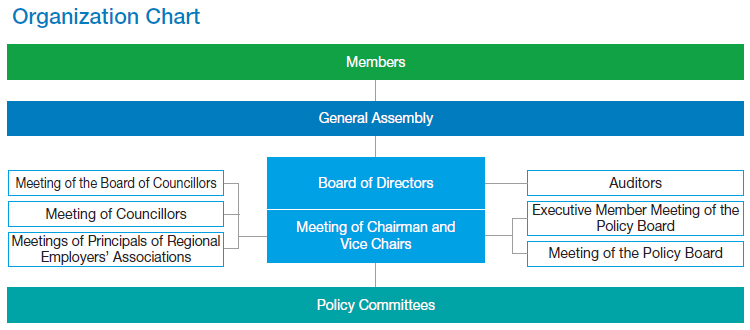
Overview of KEIDANREN
- Name:
-
Ippan Shadan Hojin Nippon Keizai Dantai Rengokai
KEIDANREN (Japan Business Federation) - Objectives (Article 3 of the Articles of Incorporation):
- The objectives of Keidanren as a comprehensive economic organization are to contribute to the self-sustained development of the Japanese economy and the improvement of the lives of citizens, by drawing out the dynamism of corporations as well as that of the individuals and communities that support them.
- Established:
- August 16, 1946
- Authorized as an incorporated association:
- June 29, 1961
- Transition to a general incorporated association:
- March 30, 2012
- Representative Directors:
-
TSUTSUI Yoshinobu, Chairman
FUJIWARA Kiyoaki, President - Directors: 26
- Auditors: 2
- KEIDANREN is a corporation with an Accounting Auditor.
- Membership:
- Auditors: 2
- Corporate members: 1,580, Group members: 150, Special members: 33,
Total: 1,763 members (as of April 1, 2026) - Secretariat:
- Staff members: 229 (including temporary staff, as of April 1, 2026)
History of KEIDANREN
Japan Federation of Economic Organizations (Keidanren) was established in August 1946, immediately after the end of World War II, with the aim of reconstruction and recovery of the Japanese economy. Keidanren's first Chairman was ISHIKAWA Ichiro (1946–56). In April 1948, Japan Federation of Employers' Associations (Nikkeiren) was launched with the objective of establishing appropriate relations between labor and management, with the motto "Employers, be righteous and strong." Nikkeiren's first Representative Executive Director was MOROI Kanichi (1948–68).
Since then, the two organizations have contributed to the development of the Japanese and global economies through maintaining and stimulating a free and open economic model and taking on internal and external challenges that the business community faced, such as promotion of free competition, liberalization of trade, promoting measures for addressing energy and environmental issues, promotion of private-sector economic diplomacy, wage negotiations, and establishment of stable labor-management relations. Keidanren's Chairman ISHIZAKA Taizo (1956–68) emphasized that the business community must take the high road of liberalization, and helped achieve liberalization of capital.
In 1966, the original Keidanren Kaikan building was completed, and the organization continued its further development. Keidanren Chairman DOKO Toshio (1974-80) used his experience gained through work on the streamlining of factory production to streamline government (administrative reform). Since the tenures of Keidanren Chairman Doko, Nikkeiren Chairman OTSUKI Bunpei (1979–87), and Nikkeiren Chairman SUZUKI Eiji (1987–91), the major roles of Keidanren and Nikkeiren in contributing to administrative and fiscal reforms have become common knowledge amongst the Japanese public.
Although Japan achieved economic growth, an era of trade friction arrived. Keidanren introduced concepts such as the "Philosophy of Endurance" of Keidanren Chairman INAYAMA Yoshihiro (1980–86), the "Open Keidanren" of Keidanren Chairman SAITO Eishiro (1986–90), the "Need for Co-existence" of Keidanren Chairman HIRAIWA Gaishi (1990–94), and "Attractive Japan" as advocated by Keidanren Chairman TOYODA Shoichiro (1994–98), so that Japanese companies would be accepted as good corporate citizens within international society.
Amid a declining birthrate and an aging population, as well as diversification in Japanese people's mindsets and values, structural reforms of the social security system, labor market, and educational system have become indispensable for enhancing business competitiveness. Therefore, in 2002, under the leadership of Keidanren Chairman IMAI Takashi (1998–2002) and others, Keidanren and Nikkeiren merged to form the Japan Business Federation, as a new comprehensive economic organization to address crosscutting issues. The first Chairman of the new Keidanren was OKUDA Hiroshi (2002–06).
In 2009, the new Keidanren Kaikan building was completed. In 2012, following changes in the legal framework around nonprofit organizations, Keidanren transitioned from an incorporated association to a general incorporated association.
In addition to formulating recommendations on specific policy issues, Keidanren has released comprehensive proposals setting out visions for the long-term future of Japan's economy and society with a wide audience in and outside Japan. These include:"Envisioning a Vibrant and Attractive Japan" (Chairman Okuda, 2003), "Land of Hope, Japan" (Chairman Mitarai, 2007), "Sunrise Report" (Chairman Yonekura, 2010), "Toward the Creation of a More Affluent and Vibrant Japan" (Chairman Sakakibara, 2015), ". The NEW Growth Strategy" (Chairman Nakanishi, 2020), and "FUTURE DESIGN 2040" (Chairman Tokura, 2024).
Of late, the international climate is becoming increasingly fluid and global-scale issues, especially rising inequality and climate change, are growing ever more severe. Amid these developments, Keidanren resolutely tackles major societal shifts such as digital transformation (DX) and green transformation (GX), and at the same time actively engages in private-sector economic diplomacy with countries and regions around the world as representative of Japan's business community.