

Keidanren (Japan Business Federation)
I. Introduction
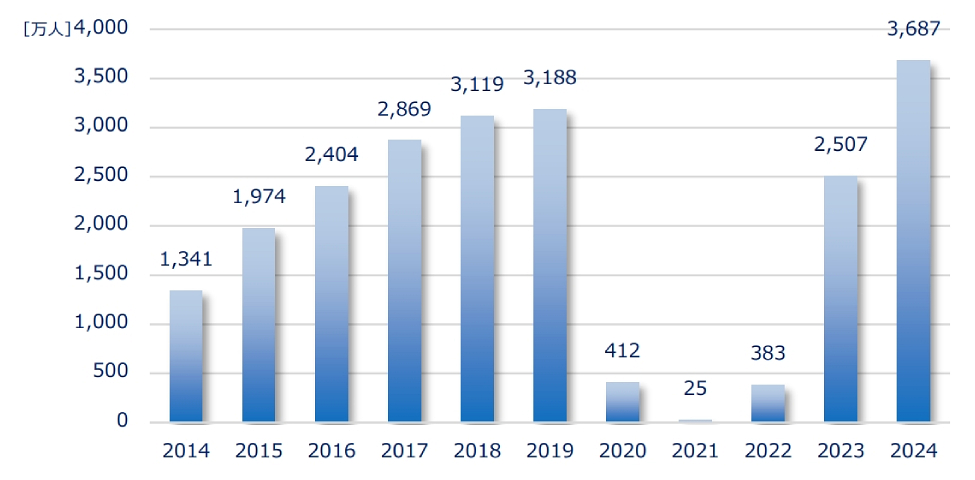
Japan's tourism has recovered from the downturn caused by the COVID-19 pandemic and has expanded dramatically, combined with the recent depreciation of the yen. In 2024, the number of inbound travellers reached approximately 36.87 million, with total spending amounting to 8.1 trillion yen, both record highs. In 2025 as well, the number has already reached 28.38 million during the January—August period, indicating a pace likely to exceed 40 million annually.
The targets set under the current Fourth Tourism Nation Promotion Basic Plan (Cabinet decision on 31 March 2023; hereinafter referred to as the "Basic Plan")—such as exceeding the 2019 inbound level (31.88 million people) and achieving 5 trillion yen in travel consumption by the end of 2025—have already been achieved ahead of schedule. While the weak yen has had a significant impact, there is no doubt that Japan's unique tourism resources—nature, culture (including food culture), history, and more—are widely recognised around the world as irreplaceable attractions that motivate visits to Japan.
Figure 1: Trends in the Number of Inbound Visitors to Japan
(Source: Japan National Tourism Organization, JNTO)
However, despite these buoyant figures, Japan's tourism industry faces severe challenges from the perspective of "sustainability." In particular, securing and developing human resources is an urgent issue in the tourism industry, which suffers from seasonal fluctuations and higher vacancy rates compared to other industries. Moreover, as the increase in tourists has made congestion and breaches of etiquette more conspicuous, the problem of so-called "overtourism," which causes friction with local residents, is becoming more serious in many areas. Furthermore, disparities between urban and rural regions are widening, as about 70% of foreign guest nights are concentrated in the three major metropolitan areas.
Against this backdrop, based on the "Innovation Towards Sustainable and Resilient Tourism"#1 (18 January 2022), which was compiled in advance of the revision of the Basic Plan, Keidanren has made recommendations to the government and other relevant parties regarding the comprehensive and systematic measures needed to realise a tourism-oriented nation. In addition, in "FUTURE DESIGN 2040"#2 (9 December 2024), Keidanren called for the development of a sustainable tourism industry that leverages regional resources such as nature, culture, and food, as well as the securing and nurturing of tourism talent, from the perspective of fostering industries that capitalise on regional resources. Furthermore, in order to respond promptly, appropriately, and flexibly to the various issues facing Japan's tourism, Keidanren established a "Working Group on Tourism Policy" under the Committee on Tourism in March 2025, and have been engaging in intensive discussions.
Even after the recently concluded Expo 2025 Osaka, Kansai, many opportunities are expected for tourists from both inside and outside Japan to visit, such as the International Horticultural Exposition (March—September 2027, in Yokohama, Kanagawa Prefecture) and the WorldSkills International Competition (November 2028, in Tokoname, Aichi Prefecture). In this context, it is imperative to revitalise domestic tourism while ensuring that the benefits of inbound demand are distributed nationwide. Looking ahead to 2030 and even 2040, Japan must shift from a focus on quantity to quality, and demonstrate its ability to establish itself as a truly sustainable tourism-oriented nation.
Accordingly, prior to the formulation of the next (Fifth) Tourism Nation Promotion Basic Plan, Keidanren sets forth the following recommendations.
II. Current Situation and Challenges
The vision articulated by the Government's Tourism Nation Roundtable#3 (established in 2003)—"Creating a country that is good to live in and good to visit"—continues to serve as a fundamental guiding principle for Japan's tourism policy today. By its very nature, tourism not only involves the aspect of "seeing the light," in which visitors enjoy natural landscapes and famous sites, but also the aspect of "showing the light," in which local residents, who welcome and host tourists, can feel happiness and pride.
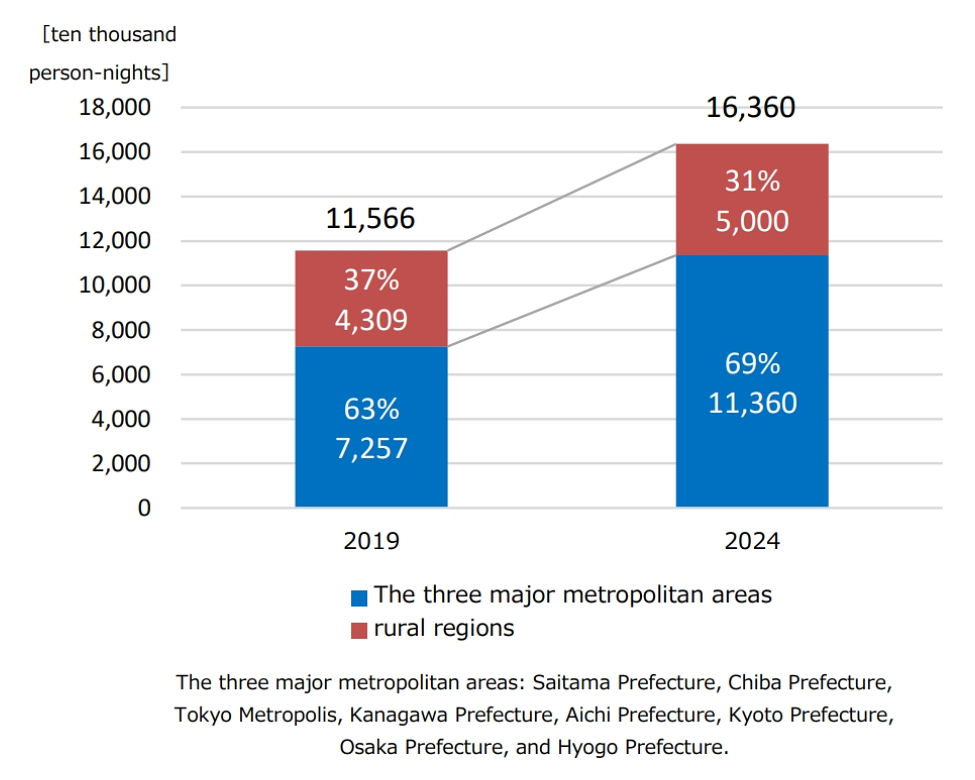
However, about 70% of foreign visitors' accommodations are concentrated in the three major metropolitan areas#4, meaning that opportunities for rural regions to fully showcase the appeal of their tourism resources remain limited.
Figure 2: Breakdown of the Total Number of Foreign Guest Nights
(Source: Ministry of Land, Infrastructure, Transport and Tourism)
In some tourist destinations, overtourism—caused by congestion, breaches of etiquette, and other issues—is becoming more severe, leading not only to a decline in the convenience and satisfaction of tourists, but also to adverse effects on the daily lives of local residents. From the perspective of sustainability, these are increasingly serious problems that cannot be overlooked. Furthermore, in the tourism industry#5—where labour shortages are already acute—the urgent and medium- to long-term challenge is how to improve labour productivity, while also fostering and securing human resources.
III. Measures to be Taken Towards the Realisation of a Sustainable Tourism-Oriented Nation
1. Securing and Developing Human Resources to Support Japan's Tourism Industry
(1) Labour-saving and Improving Productivity Across the Entire Tourism Industry
With Japan's declining birthrate and ageing population leading to fewer workers in all industries, labour-saving measures and productivity improvements are especially urgent in the tourism industry, which is labour-intensive, also from the perspective of enhancing profitability. In this regard, it is essential to actively introduce flexible working styles that allow motivated individuals in the tourism sector to work according to their preferences.
The government should also make use of initiatives such as human resource shortage countermeasure projects (equipment investment subsidies) in tourism destinations and the tourism industry, thereby disseminating specific best practices#6 widely. Recognising that industries such as food service and accommodation are among the twelve sectors where labour shortages are most acute#7, the government should strongly implement a "Labor-Saving Investment Promotion Plans" over the five-year period up to FY2029, to intensively promote labour-saving investments and productivity improvements across the broad tourism sector.
(2) Securing and Developing Digital Talent for Tourism
There is growing demand to provide timely and appropriate information about tourist destinations by leveraging digital technologies, including AI, to meet diverse tourist needs. However, especially in rural areas—where proactive external communication is most needed—there is a shortage of personnel equipped with such skills. The government, in working towards its goal of cultivating 2.3 million digital professionals (FY2022—FY2026), should provide focused support to the tourism industry, where the potential for digital utilisation is high but the shortage of skilled personnel is serious, and link these efforts organically with national human resource development strategies.
(3) Promoting Tourism Human Resource Education
Keidanren has supported initiatives to develop highly skilled tourism professionals for the realisation of a tourism nation by conducting tourism internships#8, allowing students to improve their abilities through advice from host companies.
From the perspective of continuously identifying and nurturing the next generation of talent, it is important that stakeholders from industry, academia, and government work closely together to widely raise awareness among all segments of the population regarding the significance of Japan's tourism industry (for example, that the inbound tourism market, at approximately 8 trillion yen, is Japan's second-largest export industry after automobiles). Through effective communication, a shared understanding should be built regarding the value and significance of tourism within local economies and societies, as well as the diversity of related industries. Such initiatives are expected to increase the number of young people who take an interest in the tourism industry and human interactions, and who aspire to contribute as future leaders.
In addition, it is desirable to improve working environments and treatment so that especially younger generations can envision future career paths, and to expand educational and research institutions that train motivated tourism professionals. In this regard, Japan should also learn from advanced cases abroad#9 and promote collaboration among industry, academia, and government to foster management-level talent within the tourism industry#10.
2. Addressing Overtourism
(1) Dissemination of Best Practices
There is no doubt that appropriate measures must be taken to address the increasingly serious issue of overtourism in order to achieve a sustainable tourism-oriented nation. In many cases, congestion has led to noise, littering, and other behaviours that fuel resentment among local residents. Ensuring the safety and security of communities, which are primarily places of daily life, is essential. Moreover, careful attention must be paid to avoid alienating high-end tourists—who should be an important target market—and to prevent the loss of business opportunities.
Under the Overtourism Countermeasure Project (FY2023 supplementary budget), the government has selected 26 model regions#11 that are pioneering preventive and mitigating initiatives. Going forward, it is necessary to share specific good practices widely, balancing tourist reception with the quality of life for local residents, while respecting local circumstances and preferences, and working together to realise the desired outcomes.
(2) Effective Information Dissemination Using Social Media and Influencers
To promote understanding of Japan's customs and public manners, efforts that combine cultural content such as anime and manga with social media outreach via influencers can be highly effective. At the same time, it is important to consider the viral nature of social media and to ensure that adequate systems for reception are in place. The following types of approaches may be effective:
① Expanding Reach Through Multilingual Communication
- Request influencers to post in multiple languages (especially English, Chinese, and Korean).
- Share information on cultural backgrounds and manners to prevent misunderstandings or disputes.
② Promoting Sustainable Travel
- Encourage posts on themes such as "respect for local communities and residents" and "taking trash home."
- Use hashtags such as #SustainableJapan to nudge behavioural changes towards rule compliance and value respect among inbound tourists.
③ Sharing Information on Congestion Times and Areas
- Provide real-time content visualising congestion levels to help disperse tourist flows.
④ Encouraging the Rediscovery of Tourist Spots
- Request influencers to cooperate in campaigns that promote rediscovery.
- Promote posts introducing local attractions and lesser-known sites.
⑤ Creating Content Together with Local Residents
- Share videos and stories featuring local people to cultivate respect and attachment to destinations.
- This can allow travellers to feel a sense of familiarity even before visiting.
(3) Strengthening Measures Against Illegal and Nuisance Behaviours
Alongside the expansion of inbound tourism, illegal practices and nuisances have become more visible, such as unlicensed taxi services ("shirotaku"), illegal short-term rentals, and fraudulent reselling of accommodation reservations. These not only hinder the sound and sustainable development of Japan's tourism but also risk undermining public understanding and support. The government must strictly respond to such acts, including by introducing necessary regulations when appropriate.
As part of this, enforcement should be strengthened against both Japanese and foreign offenders, to ensure that neither legitimate businesses nor well-behaved tourists suffer disadvantages. Beyond illegal practices, it is also essential to foster understanding and respect for widely accepted manners and customs in Japanese society. Efforts must be made to prevent misunderstandings or inappropriate conduct arising from differences in values and social norms, by strengthening multilingual information dissemination.
Moreover, responses to accidents or incidents involving foreign tourists currently rely heavily on local fire departments, police, and hospitals. The surge in inbound visitors has therefore increased human and financial burdens on these institutions. In promoting future tourism policies, it is required to integrate a tourism perspective into social infrastructure, and to allocate appropriate budgets and provide support for establishing necessary systems.
3. Development of Autonomous Tourism
(1) Promoting Regional Dispersion and Attracting Visitors to Rural Areas
As noted earlier, with about 70% of foreign guest nights concentrated in the three major metropolitan areas, regional dispersion is an effective measure to alleviate overtourism. However, efforts to attract visitors to rural areas remain insufficient.
To achieve both regional revitalisation through tourism and correction of excessive urban concentration, it is necessary for each region to highlight its unique charms and characteristics, and to advance tourism policies in conjunction with regional revitalisation initiatives. As part of this, farm-stay tourism (nōhaku)—which allows visitors to stay in rural villages and enjoy local food and experiences utilising regional resources—is an important initiative for enhancing both the quality and quantity of rural stays and should be continuously promoted.
Given that many inbound travellers cite experiencing Japanese food culture as one of their purposes of travel#12, food experiences in rural areas can serve as a driver of ongoing consumption demand even after tourists return home. While accommodating diverse dietary needs of inbound visitors, Japan should view the growth of inbound tourism—including farm stays—as an opportunity to promote domestic agricultural products and foodstuffs, raise international recognition of the Japanese food brand, and pursue export expansion in collaboration with tourism.
(2) Strengthening the Functions of DMOs (Destination Management/Marketing Organisations)
To address challenges such as correcting overtourism and promoting regional tourism, DMOs must play a vital role as "command centres," enhancing services on a regional basis and drawing out the ability of regions to "earn," while also tackling these issues from an area-management perspective.
Particularly as Japan faces nationwide challenges of population decline and ageing, strengthening and developing industries that maximise local resources will require initiatives at broader regional levels (such as prefectural or regional blocs). These should include tourism management, productivity improvements, workforce development, and the development and refinement#13 of tourism resources#14.
It is also essential to build resilience in the tourism industry at the regional level during normal times, in light of repeated natural disasters and lessons learned from the COVID-19 pandemic. Moreover, the lessons and innovations accumulated during past recoveries and reconstructions should be systematically organised and shared across regions, with due consideration for the intentions and sentiments of stakeholders and communities.
To promote regional tourism using DMOs and to create high value-added inbound destinations, it is crucial to boldly implement the following measures:
① Promoting Broader Regional Collaboration
- Support for organically linked collaboration among three levels of DMOs:
- (a) regional blocs,
- (b) multiple local governments,
- (c) municipalities.
- Infrastructure investment to improve the convenience of regional airports and public transportation.
② Expanding Financial Support and Granting Necessary Authority
- Increase subsidies for DMOs' data analysis, marketing, and human resource development.
- Provide grants for surveys and system development to enable region-specific tourism strategies.
- Prepare the environment necessary for introducing tourist restrictions in congested areas (e.g., timed-entry reservations or fee-based systems).
③ Human Resource Development and Support for Specialists
- Establish government-led training programmes to upskill DMO staff.
- Introduce expert-dispatch systems for professionals knowledgeable in tourism management and inbound strategies.
④ Support for Data Sharing and Digital Infrastructure
- Support the development of integrated data platforms including tourist flow data, congestion levels, spending#15, and satisfaction.
- Promote DX (digital transformation) to improve the quality of regional tourism.
(3) Developing the Environment for Accepting Visitors in Rural Areas
① Strengthening the Functions of Regional Airports
In 2024, 81% of the 36.87 million inbound visitors used four airports: Haneda, Narita, Kansai International, and Fukuoka. With a further increase of approximately 20 million inbound visitors expected, in addition to strengthening hub functions at metropolitan airports, Japan must present a vision for utilising regional airports and establish supporting systems.
Expanding the capacity of regional airports as gateways is vital for ensuring that the benefits of inbound tourism are spread to rural areas. Consideration must be given to incentives for using regional airports, balancing inbound and outbound flows, and ensuring sustainability.
However, challenges have been pointed out: soaring construction costs, chronic shortages of ground-handling and security personnel, inadequate CIQ (Customs, Immigration, Quarantine) functions, and fuel supply shortages—issues that cannot be solved by the ingenuity of private businesses alone. It is therefore desirable to steadily promote automation and labour-saving through digital technologies, while also considering public support measures when additional airport investments are not feasible.
② Securing Secondary Transportation
Ensuring secondary transportation is indispensable both for attracting tourists to rural areas and for enabling DMOs to exercise their management capacity. It is also directly linked to regional economic revitalisation.
At present, many rural tourist destinations suffer from reductions or eliminations of public transport such as trains and buses, limiting tourists' travel options and often leaving inadequate access from airports or stations to destinations. While new transport services such as Mobility as a Service (MaaS) and shared bicycles are being introduced in some areas, nationwide adoption has yet to be realised.
Considering issues such as the costs of maintaining transport infrastructure, mismatches with tourist demand, insufficient information dissemination, and the lack of inter-regional transport networks that make wide-area tourism difficult, it is necessary for national and local governments to take the lead in implementing measures such as:
- Supporting the development of secondary transport: enhancing transport links between regional airports and cities, and improving access to tourist sites.
- Ensuring the sustainability of regional transport: formulating transport plans in collaboration with local governments and DMOs, backed by financial support.
- Strengthening inbound responsiveness: developing MaaS platforms, and multilingual taxi apps and shared-cycle services.
- Promoting universal tourism: building transport systems accessible to the elderly and disabled.
- Advancing tourism DX: digitalising transport information, ensuring multilingual access, and promoting cashless payment systems.
4. Other Important Issues
(1) Establishing Tourism Industry Policy
It is necessary to establish industrial policies that enhance the profitability of domestic businesses across the entire tourism value chain (including reservations, accommodation, transportation, consumption, and payments). The tourism industry should be regarded as a strategic industry that promotes innovation and virtuous cycles in local economies, with unified support from relevant ministries and agencies.
At the same time, to secure a level playing field internationally, Japan must pursue public-private initiatives that enable domestic businesses not only to thrive in inbound and outbound tourism but also to find opportunities in broader global markets. This will expand Japan's tourism footprint worldwide and enhance its international presence, including through soft power.
(2) Attracting High-Value-Added Travellers
High-value-added travellers#16 account for only about 1% of all inbound visitors (approximately 320,000 people), yet their spending represents around 14% (about 670 billion yen). For example, adventure tourism#17 is noted for its high per-trip spending and is attracting attention as a promising field for drawing such travellers. To expand inbound consumption, strategically capturing high-spending travellers is critically important.
However, a shortage of internationally qualified guides capable of meeting this demand has become a challenge. Guides are expected to possess not only language proficiency and knowledge of local resources, but also presentation skills, the ability to plan entertaining experiences, and—in some cases—advanced outdoor or safety management skills. Developing such expertise requires significant time and resources.
To cultivate these specialised human resources, it is effective to raise awareness about the appeal and fulfilment of guiding as a career, foster an environment where guides can earn fair compensation commensurate with their skills, and encourage recognition of guiding as a professional occupation.
(3) Promoting the Even Distribution of Tourism Demand and Diversified Tourism
In Japan, travel demand tends to concentrate during long holidays and weekends. This creates congestion in transportation and accommodations during peak periods, leading to decreased convenience and dissatisfaction among tourists.
In this context, promoting even distribution of tourism demand through new forms of leisure, such as encouraging vacation-taking, workations#18, "learncations#19," and expanded dual-residency, is worth consideration. It is important to foster public acceptance of new forms of tourism through close public-private collaboration, while encouraging flexibility in workplace and school rules.
Such efforts would help smooth demand, contribute to stabilising employment in the tourism industry, and promote more diverse forms of tourism experiences.
(4) Promoting MICE (Meetings, Incentives, Conferences, and Exhibitions)
MICE not only helps attract visitors to rural areas#20 and smooth demand but also brings broader benefits, including the promotion of international exchange and economic ripple effects#21. Business events, which constitute a major component of MICE, are often held on weekdays, thus avoiding overlap with peak domestic leisure demand, providing significant advantages to host regions.
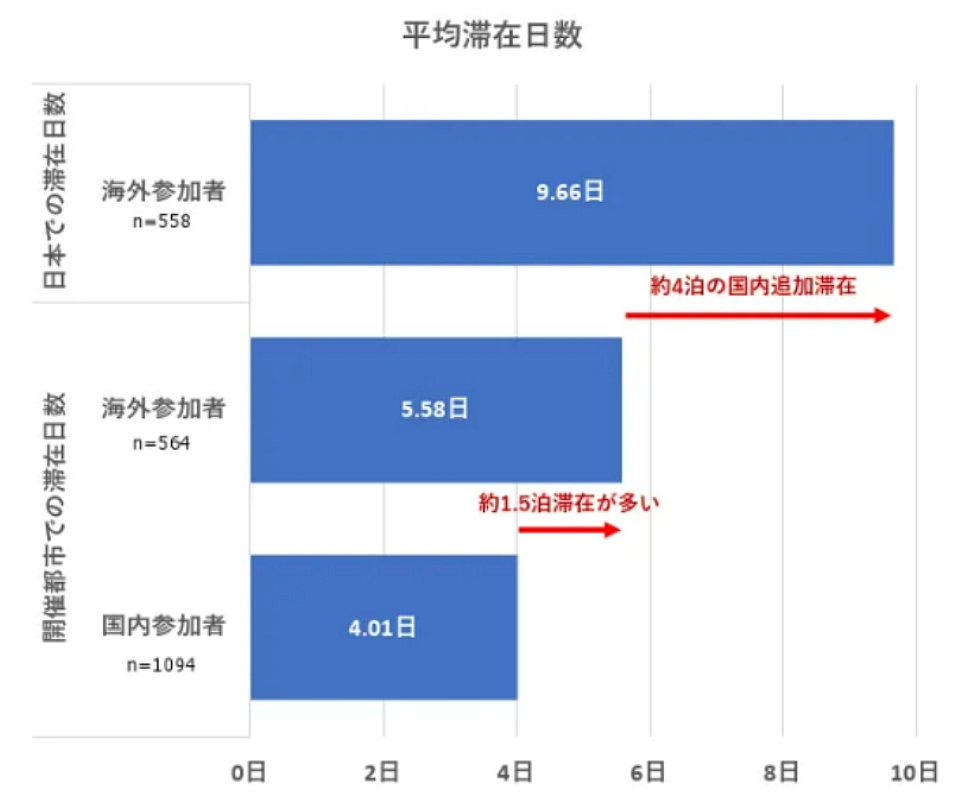
According to surveys, international conference participants from abroad extend their stays by an average of about four nights beyond the event, showing strong compatibility with long-stay tourism.
Figure 3: Trends in Length of Stay of International Conference Participants
(Source: Japan Tourism Agency, "Demonstration Project Report on Enhancing the Attractiveness of International Conferences," March 2025)
As a platform for international exchange, MICE also facilitates the acquisition of new knowledge, joint research, and innovation through networking with overseas counterparts, while at the community level, it can create diverse opportunities for grassroots international exchange. Ultimately, such initiatives are expected to foster international awareness among Japanese citizens and promote outbound tourism.
To maximise the benefits of MICE, it is essential to effectively promote the attractiveness of host destinations both domestically and internationally. To achieve this, it is necessary to strengthen cooperation between convention bureaus responsible for attracting MICE and related tourism organisations such as regional and broad-area DMOs, thereby building a unified system for welcoming visitors across entire regions.
(5) Tourism-Related Taxation
① Use of the International Tourist Tax
The International Tourist Tax (introduced in 2019 to secure tourism-related funding) is governed by the "Basic Policy on the Use of the International Tourist Tax,"#22 which emphasises that its use must be accepted by taxpayers under the principle of fairness and benefit.
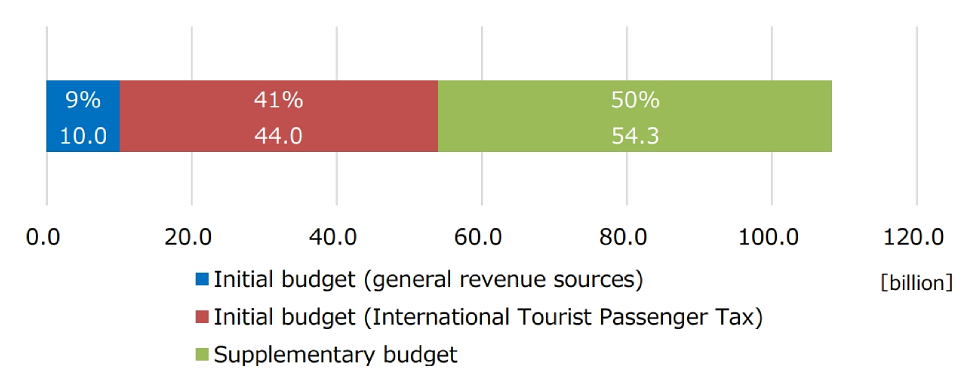
This tax (1,000 yen collected from each departing passenger, whether Japanese or foreign) accounted for approximately 44 billion yen—around 40%—of the Japan Tourism Agency's FY2024 budget.
Figure 4: FY2024 Budget of the Japan Tourism Agency
(Source: Compiled by Keidanren Secretariat from JTA budget documents)
However, as the tax is levied not only on foreigners but also on Japanese nationals, it has been difficult to demonstrate clear benefits to Japanese taxpayers. From the perspectives of fairness and transparency, it would be desirable for the tax revenue to be used in ways that visibly benefit Japanese citizens, such as addressing overtourism, providing subsidies for passport acquisition#23, supporting outbound travel, and funding human resource development and capital investment.
Considering that many inbound tourists are motivated by cultural content such as manga and anime, it may also be worth exploring the use of tax revenues to support the promotion of content industries, which significantly contribute to inbound tourism.
② Accommodation Tax
Some local governments have introduced accommodation taxes (special-purpose local taxes levied on overnight guests). These taxes are expected to provide funding for tourism promotion, infrastructure development, and measures against overtourism, thereby revitalising local economies. Going forward, it will be important to further examine appropriate tax rates tailored to regional circumstances, ensure transparency in how the revenues are used, and establish proper mechanisms for operation in order to generate positive fiscal cycles in rural areas.
(6) Promoting Outbound Tourism
While the above proposals have mainly addressed inbound tourism, it is important to remember that tourism is inherently a reciprocal and mutually beneficial activity (inbound and outbound). Despite recovery in inbound tourism post-COVID, outbound tourism remains sluggish#24, largely due to the higher costs associated with yen depreciation. In the long run, however, this stagnation risks severely undermining Japan's international competitiveness.
A decline in human exchange, study abroad, and business travel would ultimately weaken Japan's international presence. Therefore, the following initiatives are required:
① Simplifying Travel Procedures
- Expand visa exemptions in cooperation with destination countries, and streamline visa acquisition processes.
② Dispel Anxiety About Overseas Travel and Provide Support
- Strengthen the dissemination of travel safety information in clear and timely ways.
- Promote "安心パック" (safety assurance packages) such as travel insurance and apps offering assistance in case of trouble.
③ Cultivating International Awareness and Education Support
- Enhance overseas experience programmes for young people through international exchanges, study abroad, and student exchanges.
- Invest in language education, especially practical English instruction from primary and secondary school levels.
- Promote citizen participation in international conferences and other platforms for exchange, leveraging MICE as opportunities for interaction.
④ Supporting Overseas Business Expansion
- Provide local information and expert-dispatch systems through expanded support from public institutions such as JETRO.
⑤ Public-Private Joint Information Dissemination
- Promote two-way exchange through "Cool Japan" initiatives that showcase Japanese culture.
- Launch travel campaigns using social media and foreign media to effectively communicate Japan's appeal as a travel destination.
⑥ Other Initiatives
- Promote "Tourism Exchange Years" between countries to stimulate sister-city exchanges, cultural exchange, and student exchanges.
IV. Conclusion
It has been exactly a quarter of a century since Keidanren first released its proposal "Recommendations on the Future of Tourism in Japan in the 21st Century — Towards the Creation of a New Nation" (17 October 2000)#25. During this period, Japan's tourism has made remarkable progress, including the establishment of the Japan Tourism Agency and the dramatic growth of inbound tourism.
Even in this changing environment, the essence of tourism—"to see the light of the nation"—remains unchanged. However, following the end of the global pandemic that struck the tourism industry, coupled with the rapid depreciation of the yen, inbound consumption has certainly benefited Japan's broad-based tourism industry. At the same time, distortions that were not initially anticipated—such as overtourism—have also emerged. Furthermore, the delayed recovery or potential shrinkage of domestic tourism is a concern that cannot be ignored when considering regional revitalisation.
It is no exaggeration to say that Japan's tourism policy has reached a critical turning point. In this context, while shifting from quantity to quality, it is essential to pursue tourism and regional development that can truly realise the dual vision of being "a country good to live in and good to visit," under the spirit of both "respect" and "welcome."
Based on this proposal, Keidanren intends not only to continue making requests to the government and relevant authorities, but also to advance every possible initiative to address the issues at hand.
- Keidanren: "Innovation Towards Sustainable and Resilient Tourism" (2022-01-18)
- Keidanren: "FUTURE DESIGN 2040" (2024-12-09)
- Based on Keidanren's first proposal on tourism, "A Proposal on Japan's Tourism in the 21st Century — For a New Nation-Building" (17 October 2000), which served as part of the government's response.
- The ratio of overnight stays by foreign visitors (three major metropolitan areas vs regional areas) widened from 63% (72.57 million person-nights) to 37% (43.09 million person-nights) in 2019, to 69% (113.6 million) to 31% (50 million) in 2024 (Source: Accommodation Travel Statistics, 2024 preliminary figures).
- The government designated 12 industries—including food services, accommodation, retail, transport, and agriculture, forestry, and fisheries—as sectors suffering particularly severe labour shortages (Cabinet decision, Grand Design and Action Plan for a New Form of Capitalism — 2025 Revised Version, 13 June 2025).
- For example, the 2025 amendment (March notification) to the Inns and Hotels Act eased front-desk regulations, allowing identity verification and information confirmation via automated check-in machines, eliminating the need for face-to-face interactions with staffs.
- Grand Design and Implementation Plan for a New Form of Capitalism — 2025 Revised Edition (Cabinet Decision, 13 June 2025).
- Example from last year: Keidanren Tourism Internship Industry—Academia Joint Report Meeting Held (21 November 2024, No.3660) | Keidanren Times Weekly.
- At Cornell University (USA), an online course titled Sustainable Tourism Destination Management is offered, fostering knowledge and skills (e.g., capabilities and leadership required for environmentally friendly and fair and efficient destination management. Sustainable Tourism Destination Management | Cornell SC Johnson
Similarly, Switzerland's École hôtelière de Lausanne offers an MBA programme for aspiring hotel general managers and executives. EHL Hospitality Business & Hotel Management School Switzerland - In Japan, certain universities have established tourism-focused MBA courses (Hitotsubashi University: 2018; Ritsumeikan University: 2024).
- Examples of public transport congestion measures: ①Kyoto: new "tourist express buses," guidance towards subways, expansion of "hands-free tourism." ②Niseko: expansion of the "Niseko Model" to tackle taxi shortages. ③Zao: consideration of dynamic pricing for ropeways, congestion visualisation. ④Kawagoe: strengthening park-and-ride systems, dissemination of congestion information. ⑤Hakone: using the "Hakone Tourism Digital Map" to promote dispersion and demand smoothing. ⑥Izumo Taisha: introduction of variable parking fees. ⑦Shodoshima: improving public transport and real-time congestion updates. ⑧Ginzan Onsen: reducing traffic jams via park-and-ride and shuttle buses. Examples of countermeasures against poor manners: ⑨Biei: use of AI cameras to deter trespassing on private farmland. ⑩Kamakura/Fujisawa: installation of cameras to discourage improper photo-taking behaviour. ⑪Shirakawa-go: enhancing pre-trip etiquette education based on travellers' country/region. ⑫Nara Park/Yamanobe Road: visitor participation in landscape conservation. ⑬Takayama: etiquette education for preserving traditional scenery, efficient information sharing in disasters. Environmental protection: ⑭Iriomote Island: introduction of entry restrictions under the Ecotourism Promotion Act. ⑮Oirase: enforcement of vehicle entry restrictions. User charges: ⑯Mt. Fuji (Yoshida Trail): setting climber limits and introducing a toll system. ⑰Other Mt. Fuji routes: introducing an online climbing registration system. ⑱Aso: promoting EVs and bicycles to reduce environmental burden. Demand dispersion: ⑲Miyajima: improving terminals, visualising congestion. ⑳Asakusa: crowd control measures near Senso-ji Temple. ㉑Sado Island: strengthening secondary transport. ㉒Koyasan: using data to disperse visitors. ㉓Niyodo River Basin: improving facilities for new tourist spots. ㉔Chichibu: AI-based congestion forecasting. ㉕Ōtsuki: developing new touring content near Mt. Fuji. ㉖Naha: providing parking congestion info and promoting public transport use.
- According to the Inbound Consumption Trend Survey (Japan Tourism Agency, 2024), "eating Japanese food" ranked first, with 82.2% of visitors selecting it as an anticipated activity before visiting Japan.
- For non-tourism resources such as landscapes or festivals, collaboration with local stakeholders is necessary to prevent damaging their original purpose or value.
- Keidanren: FUTURE DESIGN 2040 (9 December 2024).
- To accurately capture inbound spending on food and experiences, apps could be used to gather data from foreign visitors.
- The Japan Tourism Agency's Action Plan for Developing High-Value-Added Inbound Destinations in Regional Areas (May 2022) defines a "high-value-added traveller" as one who spends over ¥1 million per trip.
- Defined by the Adventure Travel Trade Association as travel combining at least two of three elements: (1) activity experience, (2) nature experience, and (3) cultural experience.
- a blend of "work" and "vacation," referring to working remotely while enjoying leisure
- a blend of "learning" and "vacation," meaning educational trips where school absences on weekdays within a certain limit are not counted as official leave
- In 2024, 44% of international conferences in Japan were held outside the three major metropolitan areas (Source: ICCA data).
- The total economic ripple effect of international MICE events in 2023 was approximately ¥892.33 billion (Japan Tourism Agency, FY2024 Report on the Economic Impact of MICE).
- Cabinet decision by the Ministerial Council for the Promotion of Japan as a Tourism-Oriented Nation, 24 December 2021 (partially amended on 27 December 2024).
- Japan's passport ownership rate is 17.8% (2024), far below that of other major countries (South Korea 40%, Taiwan 60%, USA 50%).
- Outbound travellers numbered 9.62 million in 2023 and 13.01 million in 2024, still below the 2019 level of 20.08 million (Japan Tourism Statistics Database).
- Keidanren Opinion Paper: A Proposal on Japan's Tourism in the 21st Century — For a New Nation-Building (17 October 2000).